Skip to content
mr pakistani
  • AIOUExpand
    • BA Assignments
    • Matric Assignments
    • F.A/I.Com Assignments
    • BA Guess Papers
  • ToppersExpand
    • 9th Class Toppers
    • 10th Class Toppers
    • 11th class toppers
    • 12th Class Toppers
  • Contact Us
mr pakistani

Complete FGEI SST June 2025 Past Paper with Answers

FGEI Old Paper June 2025 Solution

FGEI SST Old Paper June 2025 Solution

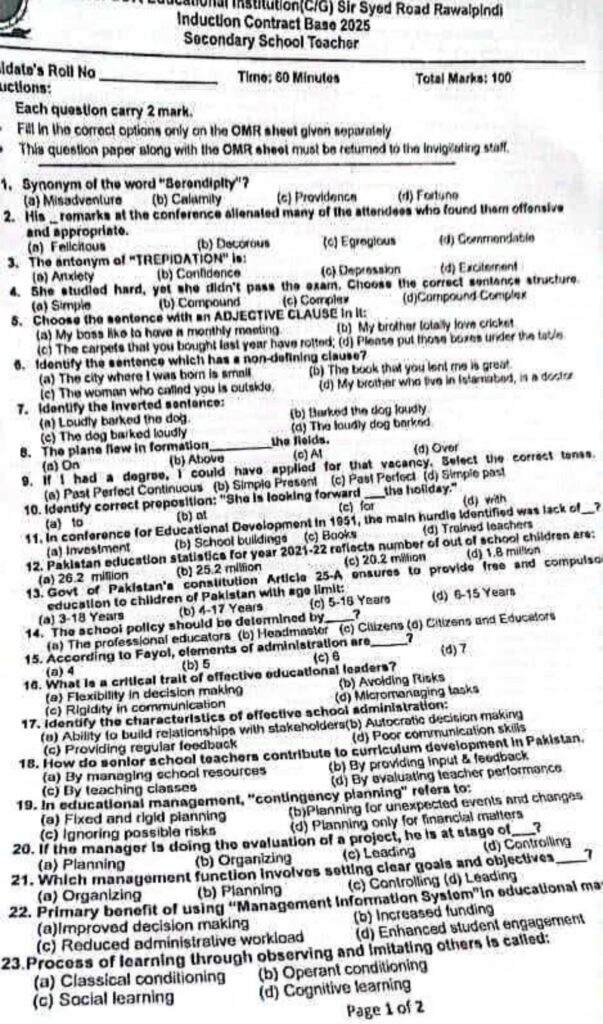
1. Synonym of the word “Serendipity”?

a. Misadventure
b. Calamity
c. Providence
d. Fortune
Explanation: “Serendipity” means a happy or beneficial discovery by chance. “Providence” also refers to the protective care of a higher power or fate—both imply fortunate, unintended outcomes.

2. His remarks at the conference alienated many of the attendees who found them offensive and inappropriate.

a. Felicitous
b. Decorous
c. Egregious
d. Commendable
Explanation: “Egregious” means outstandingly bad or shocking—appropriate to describe offensive and inappropriate remarks.

3. The antonym of “Trepidation” is:

a. Anxiety
b. Confidence
c. Depression
d. Excitement
📚 Explanation:

Trepidation:
A feeling of fear, nervousness, or anxiety about something that may happen (source: Oxford Languages).
Confidence:
A feeling of self-assurance and lack of fear — this is the direct opposite of trepidation.

4. She studied hard, yet she didn’t pass the exam. Choose the correct sentence structure:

a. Simple
b. Compound
c. Complex
d. Compound-Complex
Explanation: This sentence has two independent clauses—”She studied hard” and “she didn’t pass the exam”—joined by the coordinating conjunction “yet.” Since no dependent clause is present, this is a Compound sentence, not Compound-Complex.

5. Choose the sentence with an ADJECTIVE CLAUSE in it:

a. My brother totally loves cricket
b. The carpets that you bought last year have rotted
c. Please put those boxes under the table
d. My brother gave me a bat
Explanation: “That you bought last year” describes “the carpets” and is an adjective clause.

6. Identify the sentence which has a non-defining clause:

a. The city where I was born is small
b. The book that you lent me is great
c. The woman who called you is outside
d. My brother who lives in Islamabad, is a doctor
Explanation: Non-defining clauses provide extra information and are set off by commas. “Who lives in Islamabad” is extra info about “my brother.”

7. Identify the inverted sentence:

a. Loudly Barked the dog
b. The loudly dog barked
c. The dog barked loudly
d. The dog loudly barked
Explanation: Inversion occurs when the verb comes before the subject, as in “Loudly Barked the dog.”

8. The plane flew in formation ___ the fields.

a. On
b. Above
c. At
d. Over
Explanation: “Above” is used when something is at a higher level than something else but not necessarily directly over it.

9. If I had a degree, I could have applied for that vacancy. Select the correct tense:

a. Past Perfect Continuous
b. Simple Present
c. Past Perfect
d. Simple Past
Explanation: This is a third conditional sentence. The condition “If I had a degree” uses the **past perfect** tense to indicate an unreal past condition.

10. Identify correct prepositions: “She is looking forward __ the holiday.”

a. to
b. at
c. for
d. with
Explanation: The phrasal verb “look forward to” is always followed by the preposition “to,” and then a noun or gerund.

11. In a conference for Educational Development in 1951, the main hurdle identified was lack of

a. Investment
b. School buildings
c. Books
d. Trained teachers
Explanation: The 1951 conference identified a major hurdle in the form of a lack of trained teachers, essential for quality education.

12. Pakistan education statistics for year 2021-22 reflects number out of school children are

a. 26.2 million
b. 25.2 million
c. 20.2 million
d. 1.8 million
Explanation: As per the 2021-22 education statistics of Pakistan, around 26.2 million children were out of school.

13. Govt of Pakistan’s constitution Article 25-A ensures to provide free and compulsory education to children of Pakistan with age limit

a. 5–16 Years
b. 4–17 Years
c. 6–15 Years
d. 6–17 Years
Explanation: Article 25-A of the Constitution of Pakistan mandates free and compulsory education for children aged 5 to 16 years.

14. The school policy should be determined by

a. Headmaster
b. Citizens
c. Citizens and Educators
d. The professional educationist
Explanation: School policies are most effective when developed collaboratively by both citizens and educators. This approach brings together professional expertise from educators and real-world perspectives and values from parents, community members, and other stakeholders. Such collaboration ensures that the policies are practical, inclusive, and aligned with the broader educational goals and community expectations.

15. According to Fayol, elements of administration are —-?

a. 5
b. 6
c. 7
d. 8
Explanation: According to Henri Fayol, the elements of administration (also known as the functions of management) are:
  1. Planning – Determining the best course of action to achieve objectives
  2. Organizing – Arranging resources and tasks to carry out the plan
  3. Commanding – Leading staff and ensuring tasks are carried out properly
  4. Coordinating – Harmonizing activities and efforts to maintain balance
  5. Controlling – Monitoring progress and making necessary adjustments
These five are the **core administrative functions** outlined in Fayol’s original work. Some modern interpretations mention a sixth (like “forecasting”), but the academically and historically accepted number is five.

16. What is a critical trait of effective education leaders?

a. Flexibility in decision making
b. Avoiding Risks
c. Rigidity in communication
d. Micromanaging tasks
Explanation: Effective leaders adapt their decision-making to changing circumstances, showing flexibility and responsiveness.

17. Identify the characteristics of effective school administration

a. Ability to build relationships with stakeholders
b. Autocratic decision-making
c. Poor communication skills
d. Providing regular feedback
Explanation: An effective school administrator builds strong, respectful relationships with all stakeholders — including teachers, students, parents, and the community. This encourages collaboration, transparency, and shared responsibility, which are essential for creating a positive school culture and improving student outcomes.

– Option a (Correct): Building relationships fosters trust and teamwork, allowing for smoother decision-making and conflict resolution.
– Option b: Autocratic decision-making ignores input from staff and community, often leading to resentment and poor morale.
– Option c: Poor communication weakens leadership effectiveness and damages collaboration.
– Option d: While providing regular feedback is important, it is only one component of effective administration — not a complete characteristic on its own.

18. How do senior school teachers contribute to curriculum development in Pakistan

a. By managing school resources
b. By providing input & feedback
c. By teaching classes
d. By evaluating teacher performance
Explanation: Senior teachers play a vital role by giving feedback based on their experience and classroom realities.

19. In educational management, “contingency planning” refers to

a. Fixed and rigid planning
b. Planning for unexpected events and changes
c. Ignoring possible risks
d. Planning only for financial matters
Explanation: Contingency planning helps institutions prepare for unpredictable events by having alternate plans ready.

20. If the manager is doing the evaluation of a project, he is at stage of

a. Planning
b. Organizing
c. Leading
d. Controlling
Explanation: Evaluation is part of the controlling function, ensuring that objectives are being met and standards maintained.

21. Which management function involves setting clear goals and objectives

a. Organizing
b. Planning
c. Controlling
d. Leading
Explanation: Planning involves setting goals, objectives, and deciding in advance the actions required to achieve them.

22. Primary benefit of using “Management Information System” in educational management

a. Improved decision making
b. Increased funding
c. Reduced administrative workload
d. Enhanced student engagement
Explanation: MIS helps in collecting, processing, and analyzing data, which leads to better and faster decision-making in educational institutions.

23. Process of learning through observing and imitating others is called

a. Classical conditioning
b. Operant conditioning
c. Social learning
d. Cognitive learning
Explanation: Social learning theory by Albert Bandura states that people learn from one another through observation, imitation, and modeling.

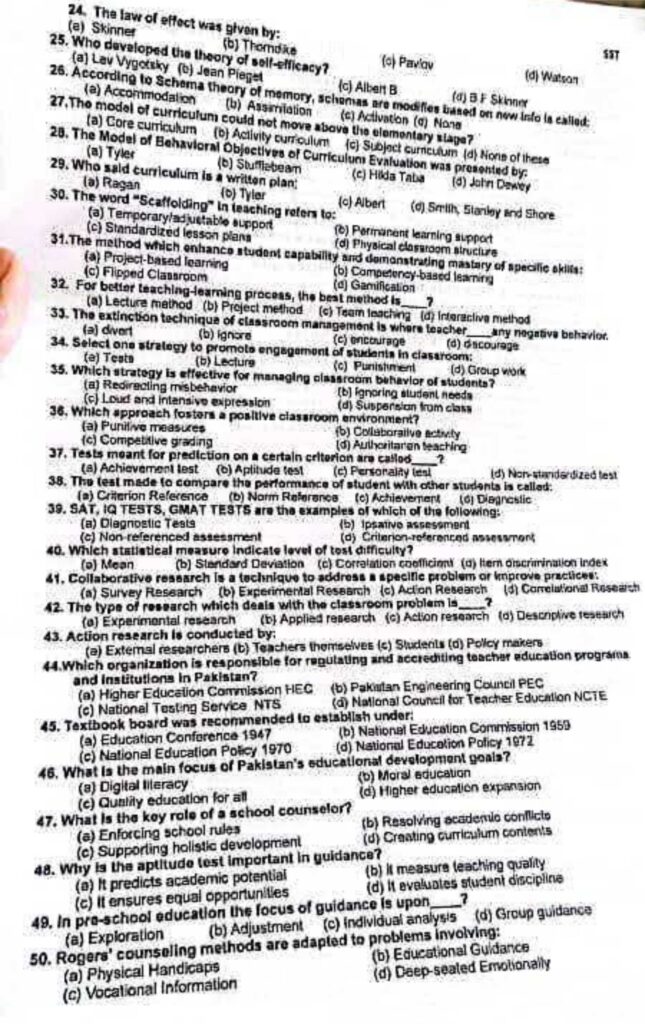
24. The law of effect was given by

a. Skinner
b. Thorndike
c. Pavlov
d. Watson
Explanation: Edward Thorndike proposed the Law of Effect, which states that behaviors followed by positive outcomes are more likely to be repeated.

25. Who developed the theory of self-efficacy

a. Lev Vygotsky
b. Jean Piaget
c. Albert B
d. B.F. Skinner
Explanation: Albert Bandura developed the concept of self-efficacy, which refers to an individual’s belief in their ability to succeed in specific situations.

26. According to Schema theory of memory, schemas are modified based on new info is called

a. Accommodation
b. Assimilation
c. Activation
d. None
Explanation: Accommodation is when existing schemas are altered to fit new information, a concept introduced by Piaget in cognitive development.

27. The model of curriculum could not move above the elementary stage

a. Core curriculum
b. Activity curriculum
c. Subject curriculum
d. None of these
Explanation: The Core Curriculum model primarily succeeded at the elementary stage because it focused on essential and foundational subjects suitable for young learners. However, it faced challenges moving beyond this stage as secondary and higher education require more specialized and flexible curricula to address diverse student needs and advanced subject matter. In contrast, the Activity Curriculum encourages learning through hands-on experiences and has been implemented beyond the elementary level. Therefore, the core curriculum is the model that could not effectively progress above the elementary stage.

28. The Model of Behavioral Objectives of Curriculum Evaluation was presented by

a. Tyler
b. Stufflebeam
c. Hilda Taba
d. None of these
Explanation: Ralph Tyler introduced the model of curriculum evaluation based on behavioral objectives, focusing on learning outcomes.

29. Who said curriculum is a written plan

a. Ragan
b. Albert
c. Smith, Stanley and Shore
d. John Dewey
Explanation: Smith, Stanley, and Shore defined curriculum as a written plan for instruction and learning processes.

30. The word “Scaffolding” in teaching refers to

a. Temporary/adjustable support
b. Permanent learning support
c. Standardized lesson plans
d. Physical classroom structure
Explanation: Scaffolding refers to the temporary and adjustable support given to students to help them achieve learning goals, which is gradually removed as they become more proficient.

31. The method which enhances student capability and demonstrating mastery of specific skills

a. Project-based learning
b. Flipped Classroom
c. Competency-based learning
d. Gamification
Explanation: Competency-based learning focuses on students demonstrating mastery of specific skills and knowledge before progressing.

32. For better teaching-learning process, the ___ is the best method

a. Lecture method
b. Project method
c. Team teaching
d. Interactive method
Explanation: Interactive methods engage students actively, improving understanding and retention during the teaching-learning process.

33. An extinction technique of classroom management where teacher ___ any negative behavior

a. Redirects
b. Ignores
c. Rewards
d. Discourage
Explanation: Ignoring negative behavior is an extinction technique that reduces its occurrence by not reinforcing it.

34. Select one strategy to engage students

a. Tests
b. Lecture
c. Punishment
d. Group work
Explanation: Group work promotes interaction and collaboration, which helps engage students actively in learning.

35. Which strategy is effective for managing classroom behavior of students

a. Redirecting misbehavior
b. Ignoring student needs
c. Loud and intensive expression
d. Suspension from class
Explanation: Redirecting misbehavior helps students correct their actions constructively without harsh penalties.

36. Which approach fosters a positive classroom environment

a. Punitive measures
b. Competitive grading
c. Collaborative activity
d. Authoritarian teaching
Explanation: Collaborative activities encourage cooperation and respect, fostering a positive learning environment.

37. Tests meant for prediction on a certain criterion are called

a. Achievement test
b. Aptitude test
c. Personality test
d. Non-standardized test
Explanation: Aptitude tests predict an individual’s ability to perform or succeed in a specific area or criterion.

38. The test made to compare the performance of student with other students is called

a. Criterion Reference
b. Norm Reference
c. Achievement
d. Diagnostic
Explanation: Norm-referenced tests compare a student’s performance to that of other students.

39. SAT, IQ TESTS, GMAT TESTS are the examples of which type of test

a. Diagnostic tests
b. Norm-referenced assessment
c. Achievement
d. Criterion-referenced assessment
Explanation: SAT, IQ tests, and GMAT are examples of norm-referenced assessments. These tests are designed to compare a test-taker’s performance to that of a defined peer group (norm group). They do not measure mastery of a specific set of content, but rather how an individual’s performance ranks among others. This allows schools and institutions to identify percentiles, rankings, or relative standing among a larger population.

40. Which statistical measure indicates level of test difficulty

a. Mean
b. Standard Deviation
c. Correlation coefficient
d. Item discrimination index
Explanation: The mean, or average score of students on a test, indicates the overall difficulty of the test. A low mean suggests that the test was difficult, while a high mean suggests it was easier. This makes the mean a direct and reliable indicator of test difficulty. Other measures like standard deviation or item discrimination index serve different purposes, such as understanding score spread or how well a question separates high and low performers.

41. Collaborative research is a technique to address a specific problem or improve practices

a. Survey Research
b. Experimental Research
c. Action Research
d. Correlational Research
Explanation: Action research is a collaborative technique aimed at solving specific problems or improving practices through iterative reflection and action.

42. The type of research which deals with the classroom problem is

a. Experimental research
b. Applied research
c. Action research
d. Descriptive research
Explanation: Action research specifically focuses on identifying and addressing problems within classroom settings through practical interventions.

43. Action research is conducted by

a. External researchers
b. Teachers themselves
c. Students
d. Policy makers
Explanation: Action research is usually conducted by teachers who systematically investigate their own classroom practices to improve student outcomes.

44. Which organization is responsible for regulating and accrediting teacher education programs and institutions in Pakistan

a. Higher Education Commission HEC
b. Pakistan Engineering Council PEC
c. National Council for Teacher Education NCTE
d. National Testing Service
Explanation: The National Council for Teacher Education (NCTE) is the main body responsible for regulating and accrediting teacher education programs in Pakistan.

45. Textbook board was recommended to be established under

a. Education Conference 1947
b. National Education Commission 1959
c. National Education Policy 1970
d. National Education Policy 1972
Explanation: The National Education Commission of 1959 recommended the establishment of textbook boards to improve educational resources in Pakistan.

46. What is the main focus of Pakistan’s educational development goals

a. Digital literacy
b. Moral education
c. Quality education for all
d. Higher education expansion
Explanation: Pakistan’s educational development goals primarily emphasize providing quality education accessible to all segments of society.

47. What is the key role of a school counselor

a. Enforcing school rules
b. Resolving academic conflicts
c. Supporting holistic development
d. Creating curriculum contents
Explanation: School counselors play a vital role in supporting the holistic development of students, including emotional, social, and academic growth.

48. Why is the aptitude test important in guidance

a. It predicts academic potential
b. It measures teaching quality
c. It ensures equal opportunities
d. It evaluates student discipline
Explanation: Aptitude tests are important because they help predict a student’s potential for success in academic and vocational fields.

49. In pre-school education the focus of guidance is upon

a. Exploration
b. Adjustment
c. Individual analysis
d. Group guidance
Explanation: Guidance in pre-school education mainly focuses on helping children adjust to the learning environment and social settings.

50. Rogers’ counseling methods are adapted to problems involving

a. Physical Handicaps
b. Educational Guidance
c. Vocational Information
d. Deep-seated Emotional
Explanation: Rogers’ counseling methods focus on addressing deep-seated emotional problems through client-centered therapy.

FGEI SST Past Paper June 2025 Complete Solution

The Complete FGEI SST June 2025 Past Paper with Answers provides a comprehensive and detailed approach to the questions asked in the Senior Secondary Teacher examination conducted by the Federal Government Educational Institutions. This solution guide is designed to help candidates thoroughly understand the concepts and question patterns typical of the SST subject. It covers all major topics with step-by-step answers, ensuring that students can prepare effectively for their exams by practicing the exact type of questions they are likely to face. The solution emphasizes clarity, accuracy, and the latest syllabus alignment, making it an essential resource for those aiming to excel in the FGEI SST exam. For more detailed solutions and updates, you can visit mrpakistani.com.

FGEI SST Past Paper – June 2025
Complete FGEI SST June 2025 Past Paper with Answers
Complete FGEI SST 2025 Past Paper with Answers

Detailed Solutions for FGEI SST June 2025 Exam

Moreover, the Complete FGEI SST June 2025 Past Paper with Answers not only provides correct answers but also explains the methodology behind each solution, enabling candidates to grasp underlying principles rather than just memorizing responses. This approach boosts confidence and improves problem-solving skills, which are critical for success in teaching-related competitive exams. Whether you are revising for your upcoming exam or looking to evaluate your performance, the FGEI SST Past Paper June 2025 Solution serves as an invaluable tool that bridges the gap between theoretical knowledge and practical application. Visit mrpakistani.com for more educational resources and past paper solutions.

  • About Us
  • Contact Us
  • Disclaimer
  • Privacy Policy
  • Terms and Conditions

Copyright © 2026 MR PAKISTANI

Scroll to top
📦 Mr Pakistani — Official Store
📚 AIOU Exam Success Bundle
⚡ Limited stock – Get verified materials for better grades!
✅ Buy Solved Guess Papers
✅ Buy Solved Assignments (Handwritten / typed)
✅ Buy AIOU Books & Key Books
✅ To Buy Books, Solved Guess, Assignments Click Here
📞 0303 6940016
💬 Join WhatsApp Channel

🛒 To buy these resources: Call or WhatsApp 03036940016. Also join our WhatsApp channel for latest updates & free tips.


📞 Contact Now (Buy) 💬 Join Updates
🔔 Join channel for solved samples & special discounts
  • AIOU
    • BA Assignments
    • Matric Assignments
    • F.A/I.Com Assignments
    • BA Guess Papers
  • Toppers
    • 9th Class Toppers
    • 10th Class Toppers
    • 11th class toppers
    • 12th Class Toppers
  • Contact Us
Search